


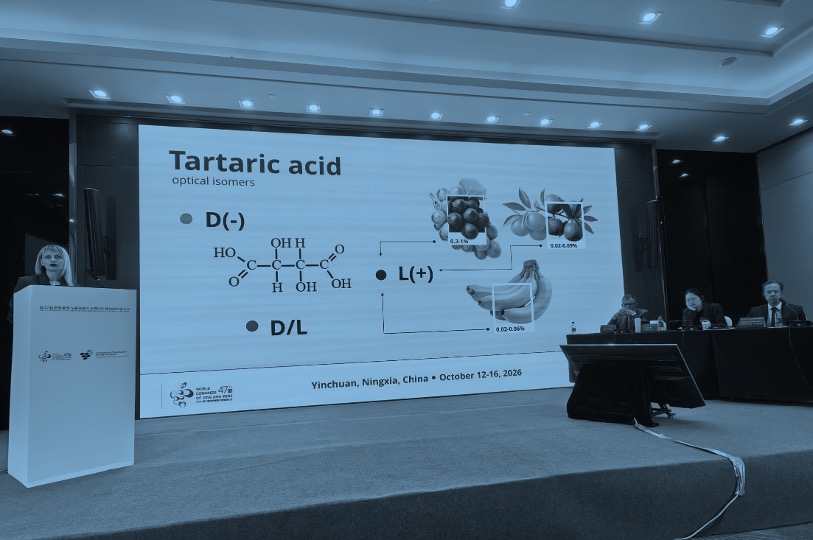
Russian scientists took part in the 47th World Congress on Vine and Wine of the International Intergovernmental Organisation of Vine and Wine (OIV), which was held from 12 to 16 October 2026 in Yinchuan, the administrative center of the Ningxia Hui Autonomous Region of the People's Republic of China. Within the congress's scientific program, Russian scientists presented reports on tartaric acid—one of the key components for the production of wine products—and on fundamental research into the metabolism of higher plants using grapevines as an example.
Official information about the congress is available on the OIV website (https://www.oiv.int/index.php/ru/О-нашей-деятельности/Конгресс-oiv) and on the event's specialized platform (https://chinawine.agri.cn/oiv2026/).
The congress, held for the first time in its history on the Asian continent, brought together leading international experts, researchers, and industry specialists to discuss the scientific, technical, and economic challenges facing global winemaking. The event was held in parallel with the 24th OIV General Assembly. More than 600 delegates from 47 countries took part in the congress, including representatives of 42 member states and 5 non-member states. Within the scientific program, 420 oral and poster presentations were delivered, and six technical visits to Chinese viticulture and winemaking enterprises were organized.
The theme of tartaric acid was addressed in reports by Olga Perekrestova (Chemical Leaders LLC) and Alexander Kolesnov (Peoples' Friendship University of Russia named after Patrice Lumumba—RUDN).
The report presented by Olga Perekrestova—“Tartaric acid - a key component for the wine industry: issues relating to the regulation of production and trade”—was prepared on the basis of work carried out jointly with RUDN and the Federal State Budgetary Scientific Institution “V.M. Gorbatov Federal Research Center for Food Systems.” The report addressed issues of regulating the production and trade of tartaric acid as a key component for the wine industry, which corresponds to the “Economics and Law” direction of the congress's scientific program.
The report presented by Alexander Kolesnov (RUDN)—“Methodological approach to studying the origin of tartaric acid contained in wine products”—was devoted to methodological approaches to studying the origin of tartaric acid contained in wine products. The relevance of this direction is linked to the need for reliable determination of the source of origin of L(+)-tartaric acid, since, according to OIV requirements, only natural tartaric acid extracted from grapes is permitted in the production of wine products to ensure their authenticity and quality.
The participation of Russian researchers in the 47th OIV Congress was ensured through financial and organizational support from Chemical Leaders LLC. The company, being the developer and patent holder for the technology for producing natural L(+)-tartaric acid (Eurasian Patent No. EA 052507), has consistently supported the participation of Russian scientists in international industry forums: previously, its representatives presented reports at the 46th World OIV Congress in Chisinau (2025) and at the anniversary 45th World OIV Congress in Dijon (2024).
The 47th OIV World Congress in Yinchuan became an important event for world science in viticulture and winemaking, providing opportunities for the exchange of scientific experience and the strengthening of international cooperation. The presentation by researchers of reports on Russian scientific achievements, including work on tartaric acid, confirms the relevance and demand for this topic in global winemaking, whose strategic development goals are ensuring quality, safety, and conditions for fair competition in the wine products market.